

At a Glance
At a Glance
Explore the history of Thai massage, from its traditional stories and Buddhist influences to Wat Pho, evolving techniques and contemporary practice.
GRANDTHAI Guide
Origins: Traditional Stories and Historical Evidence
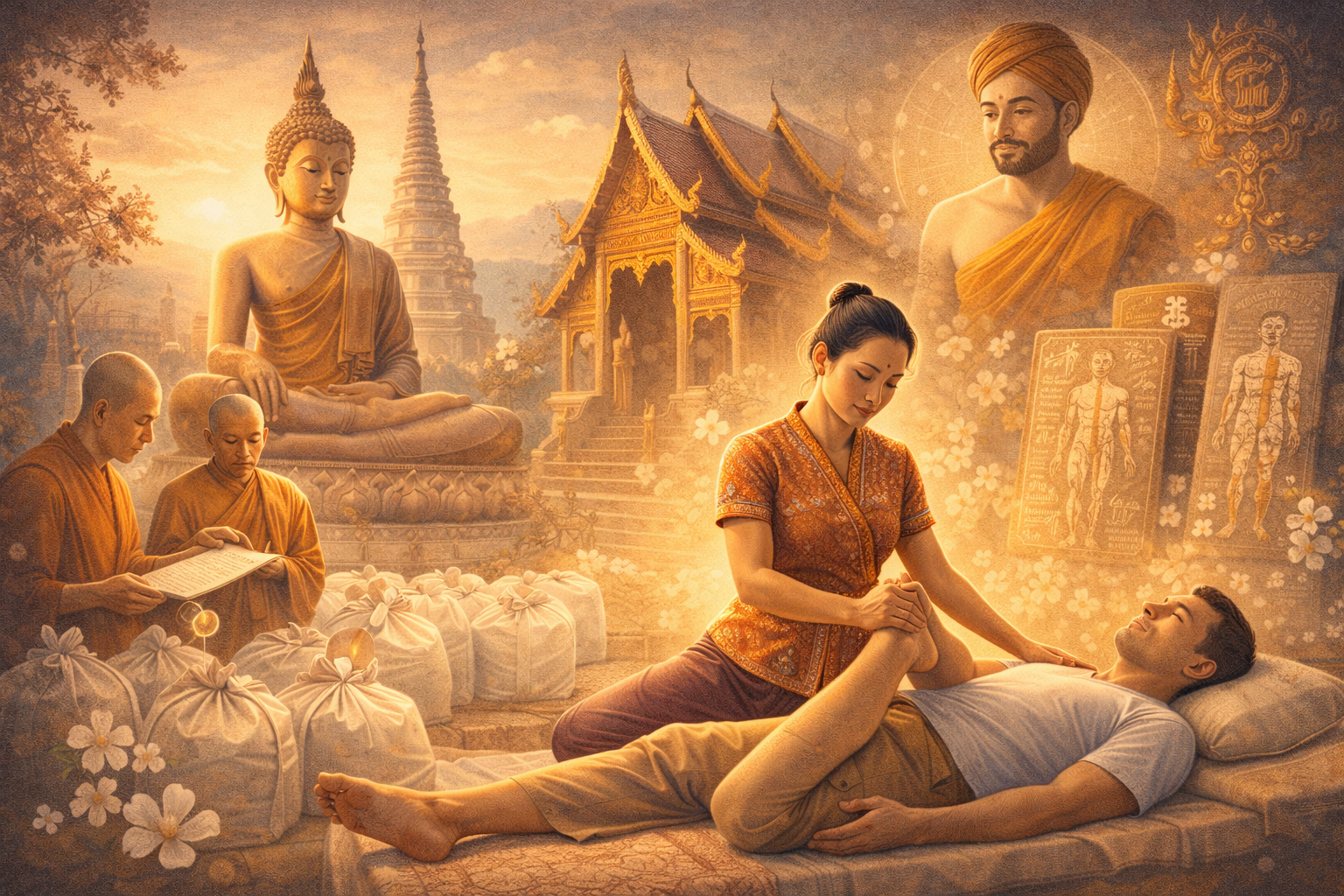
Thai massage is a living tradition shaped by different communities, teachers and periods of history. Its origins are often told through the story of Jivaka Kumar Bhaccha, a physician revered in Thai healing traditions and associated in Buddhist accounts with the Buddha.
This traditional story is important to the way practitioners understand their lineage. It should not, however, be treated as a fully documented account of one person inventing every technique practised today. Descriptions of a 2,500-year history express the tradition’s claimed roots rather than an unbroken, precisely dated record of a modern spa session.
For generations, practical knowledge was passed from teacher to student. Learning involved observing, practising and remembering sequences as well as developing an understanding of care and attention.
GRANDTHAI Guide
Indian and Chinese Influences
Accounts of Thai massage commonly describe connections with Indian traditions, including Ayurveda, and with other Asian approaches to bodywork. Ideas about balance, movement and the relationship between body and mind form part of this background.
Thai practice developed its own language and methods. Its sen lines are traditionally understood as pathways of energy, rather than simply being another name for Chinese meridians. These concepts explain a cultural framework; they do not establish a modern medical cause of illness or fatigue.
The history is better understood as a process of exchange and development than a single moment when a finished system was transferred from one country to another.
GRANDTHAI Guide
Buddhism and the Philosophy of Care
Buddhist ideas of mindfulness and compassion are closely associated with traditional Thai massage. In this understanding, the practitioner brings attention to the person receiving the treatment rather than mechanically repeating movements.
Care for the body has been connected with a wider concern for calm and balance. Massage could be seen as an act of service and a mindful practice, with importance placed on the therapist’s intention and manner as well as technique.
A contemporary guest can appreciate these values without taking part in a religious practice. Respectful contact, patience and clear communication remain meaningful in a modern spa setting.
GRANDTHAI Guide
How Knowledge Was Preserved
Oral teaching helped transmit practical knowledge, but written and visual records also became important. Wat Pho in Bangkok is a notable place of preservation and learning: its inscriptions include material on traditional medicine and massage.
The temple’s epigraphic archive dates to the nineteenth century, and massage drawings can be seen in its pavilions. These records show the importance given to preserving and sharing knowledge rather than leaving it solely to individual memory.
Temple records, teachers and practising communities all contribute to the tradition. No single surviving diagram can represent every regional style or every contemporary approach.
GRANDTHAI Guide
Massage Within Traditional Thai Medicine
Historically, massage was discussed alongside other forms of care, including herbal preparations and compresses, steam treatments and approaches to everyday living. It was not always treated as a separate leisure appointment in the way a modern visitor might encounter it.
Traditional sources describe a range of purposes, from attending to tired bodies to addressing discomfort. These historical uses should be distinguished from current evidence and from the actual service offered by a spa. A history of therapeutic use is not, on its own, proof that a present-day massage treats a particular condition.
GRANDTHAI Guide
How Techniques and Styles Developed
Thai massage has not remained unchanged. Different teachers and regions place different emphasis on pressure, assisted stretching, rhythm and the amount of movement within a session.
Traditional clothed massage may involve pressing with the hands and other carefully controlled forms of contact, together with stretches in which the guest is guided by the therapist. The practitioner uses body positioning and weight thoughtfully rather than relying only on arm strength.
The appropriate technique still depends on the individual. Traditional status does not make every movement suitable for every guest, and a professional session should respect comfort and restrictions.
GRANDTHAI Guide
Thai Massage Beyond Thailand
Travel, international interest and the work of teachers helped introduce Thai massage to a wider audience. Visitors encountered the practice in Thailand and brought an interest in learning or receiving it back to their own countries.
Schools and practitioners outside Thailand contributed to its spread, sometimes adapting teaching and treatment formats to new settings. This process brought wider recognition while also creating differences in how the term “Thai massage” is used.
For that reason, checking the actual format matters. A traditional clothed session, an oil massage and a Thai-inspired spa ritual may all appear in one catalogue but offer distinct experiences.
GRANDTHAI Guide
Thai Massage Today
Today, people encounter Thai massage in settings ranging from training schools and traditional practices to contemporary spas. Guests often choose it for relaxation, its combination of pressure and stretching, and the feeling of taking a meaningful break.
Modern presentation can change, but attention, respect for the guest and a considered rhythm remain central qualities. The value of the experience does not depend on attaching a medical guarantee to it.
GRANDTHAI Guide
The Spiritual Dimension
Some traditional practitioners begin with a moment of inward focus, a short prayer or another expression of respect for teachers. This reflects a view of massage as more than a sequence of physical actions.
The form varies between practitioners and settings. It is a description of traditional practice, not a promise that every GRANDTHAI appointment contains a religious ritual. Guests should be able to understand what their actual session will involve.
GRANDTHAI Guide
Why the History Matters
Knowing the background can make Thai massage easier to understand. The pace, use of assisted stretching and language of balance become parts of a living cultural practice rather than unfamiliar details without context.
Its story includes the passing on of knowledge, the preservation of records and the ability to adapt to new circumstances. Appreciating that history does not require accepting every traditional explanation as a scientific fact.
To explore the experience itself, compare the current Thai massage options at GRANDTHAI. Choose the format, duration and pressure that suit you, and use the history as context for an informed, comfortable visit.
Important Information
Important Information Before Your Visit
Before booking, tell our reception team and your therapist about relevant health considerations, restrictions and recent procedures.
This article is for information only and does not replace diagnosis, treatment or advice from a doctor.